A CAPA for a gowning deviation is the corrective and preventive action a plant files after an inspection observation. In a 2024 warning letter to a plant in Maharashtra, retraining was rejected as the remedy and routine supervisory oversight of every production batch was asked for instead. Annex 1 reassesses gowning at 12-month intervals.
Surveyed, installed and commissioned by our own engineers.
Three deployment models, and nobody is subcontracted.
They trust VB

















01 In their words
Nobody types these into a search box. They are what the job sounds like, and none of them is a failure of a person.

The inspector asked how many entries we had checked. I had a training register.
Nobody was ever asked to count entries before the observation was written, so the plant holds the record it was told to keep. A training register proves attendance on an afternoon. The question being asked is about a period, and no system in the building was producing that number.
Every entry through the door is checked and the check is recorded.
We wrote retraining completed, and it came back the same week.
Retraining was the accepted answer for years and it closed hundreds of deviations. What changed is not the plant's diligence, it is what an inspector now counts as a corrective action: something that keeps running after the training ends.
The corrective action is a control that runs, not an event that happened.
Nobody is standing at that airlock at two in the morning.
No quality department has the headcount to put a person at every classified door on every shift, and nobody has ever been given it. Oversight of every batch is arithmetic before it is a policy, and the arithmetic does not work with people.
The check does not depend on who is standing there.
A visitor came in behind the team, and nobody was going to stop a director.
Schedule M clause 11.5.8 reaches every person entering a production area, including visitors, contractors, senior managers and inspectors. None of them is on a training register, and a junior operator stopping a senior visitor is asking a lot of a person in a corridor.
A camera has no rank. The rule applies the same to everyone.
None of that is something anyone types into a search box. The rest of this page is the part you can act on.

02 The format
Ten fields, in the order they are completed. Field five is the one most CAPAs leave empty, and it is the one an inspector reads first.
Copied as written, with the date, the area and that area's grade.
What was done immediately. Personnel stood down, area status, product disposition.
Which batches were reviewed, by number, and what the review concluded.
What made it possible. Airlock time under schedule pressure, an unfamiliar visitor, a grade change at an adjacent door. A condition, not a person.
How many entries in the period were checked, by whom, against what. Without this the CAPA has no denominator.
The system change. What will now happen at that door on every shift, and from when.
Where else the same condition exists and what was changed there.
The measure, the period and the acceptance criterion, all defined before the CAPA is closed.
The records supporting every claim above, listed by identifier.
Quality approval with the date, and the date the effectiveness check falls due.
One worked example, built from a published inspection finding. No plant, sector or state is named on this one, because a sterile filling suite plus a state narrows to very few plants.
Yes. Nothing here is gated, there is no form to fill and no address to leave.
CAPA · GOWNING DEVIATION · RECORD FORMAT

01  OBSERVATION, VERBATIM      date, area, grade of the area
02  CONTAINMENT                what was done the same shift
03  BATCH IMPACT               batches reviewed, by number, and the conclusion
04  CONDITION INVESTIGATED     what made it possible. A condition, not a person
05  EXTENT                     entries checked in the period, by whom, against what
06  CORRECTIVE ACTION          the system change at that door, and from when
07  PREVENTIVE ACTION          where else the condition exists, and what changed
08  EFFECTIVENESS CHECK        measure, period, acceptance criterion, set in advance
09  EVIDENCE ATTACHED          records supporting every claim above, by identifier
10  APPROVAL                   quality approval date, and when the check falls due
Adapt the fields into your own quality system format and the numbering into your own document control. It is a structure, not a template to be signed as received.
Current against · revised Schedule M, Part I, clauses 11.5.6 and 11.5.8 · EU GMP Annex 1, section 7.4 · US FDA guidance on responding to a Form 483. Re-verified September 2026.
By having a count from before the observation, not only after it.
An effectiveness check written as "no further deviations observed" tells an inspector nothing, because nobody was observing. A check written as a rate over a defined period, against a criterion set before the period began, is a different document. It needs a measurement that was already running while the plant was normal, which is why the measurement has to be installed as part of the corrective action rather than promised alongside it.
Five returns, and none of them is about effort.
A training record shows who attended, not what happened at the airlock three weeks later. It remains a valid correction and it is no longer accepted as the system change.
The CAPA states that the deviation was investigated but never says how many entries were checked, over what period, against what rule. Without that the observation stands unchallenged.
"Monitor for recurrence" is not a check. The measure, the period and the pass mark all have to be written down before the CAPA closes, not chosen afterwards from whatever the data showed.
An investigation that ends at an individual has not reached the condition that produced the behaviour, so the same condition is still there on the next shift with a different person in it.
If the same grade rule runs at three doors and the CAPA changes one, the preventive section is a sentence rather than an action, and the second observation is already available to be written.
It addresses the visual half of section 7.4. It does nothing about the microbial half, and the copy on this page will not pretend otherwise.
VijAI reads the feed from cameras positioned at the final door into a classified area, checks each person entering against that area's grade rule, and writes a timestamped record of the check. It detects what is visually observable: uncovered hair, missing overshoes, exposed skin, visibly damaged gowning. A camera has no rank, so the check applies to a visiting director the same way it applies to an operator.
It makes no claim about sterility, about microbial control, or about the plant's GMP status. It does not replace gowning qualification or personnel monitoring. Settle plates, contact plates and personnel monitoring are unaffected and remain required. The standard position is the clean side of the final door, never inside the change room, and what a given site needs is settled at survey.
This page is the format. The two below are the decision and the duty.
Cameras per door, the survey, and what a 30-day run involves.
L1 · complianceWhat Schedule M and Annex 1 actually requireThe three clauses that carry the duty, and who they reach.
NextPut it to our engineering teamTell us the grade of the area and the observation you are answering.
Sources · US FDA guidance on inspections and the Form 483 response window · CDSCO, revised Schedule M · EU GMP Annex 1, manufacture of sterile medicinal products. Named, not linked.
03 See it running
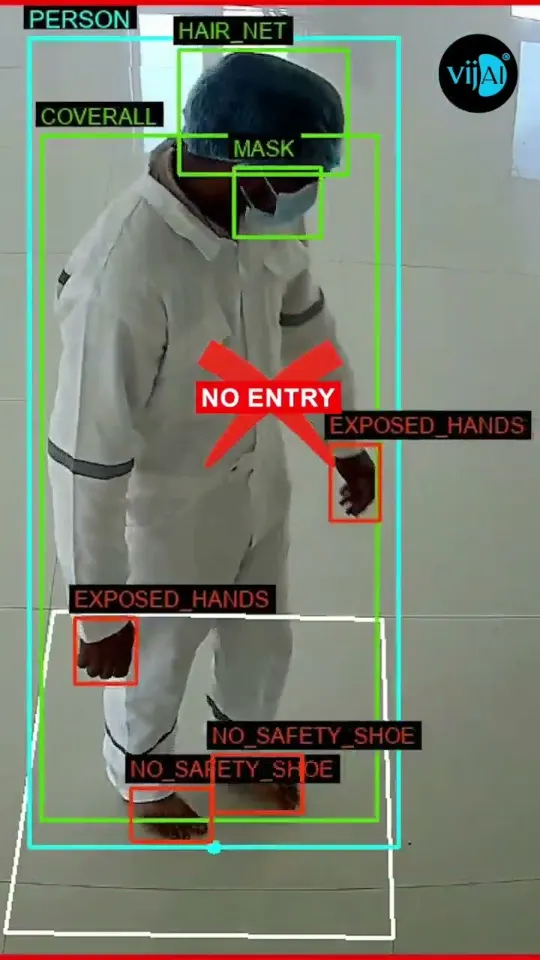
Twenty seconds from a working deployment at a pharma plant. The same person, two attempts at the same door: refused, then allowed. Nothing here is re-enacted.
 Loads from YouTube only when you press play
 Capture from a live deployment, not an illustration. Faces are covered by the gowning itself.
04 How it runs
The first question IT asks is where the video goes. All three answers are here, and detection by default with identification optional applies to every one of them.
| Model | Where the video is processed | Where it fits |
|---|---|---|
| On-premise edge | Entirely inside the plant. Nothing leaves your network. | Licensed areas, sites with a data-residency rule, and plants with no dependable outbound link. |
| HybridRecommended | Detection at the edge, dashboards and reporting hosted. Footage stays on site. Only events leave. | Most plants. Video stays inside the boundary and head office still gets one view across every site. |
| Cloud | Processing and storage hosted. | Single sites, short pilots, and estates already running their VMS this way. |
The model is chosen in the survey, against your network and your data rules. It is not a price tier.
05 Who installs it
Survey, engineering, installation, commissioning, calibration, training and support are all done by VB people. When a camera angle is wrong on a Sunday night, the person who fixes it is the person who chose it.
06 Before you write it
Retraining remains a valid correction. It is increasingly rejected as the whole corrective action, because a training record shows who attended, not what happened at the airlock afterwards.
Something contemporaneous, attributable and covering the period in question rather than a sample day.
Yes. Revised Schedule M Part I clause 11.5.8 extends the duty to all persons entering production areas, including contractors' employees, visitors, senior managers and inspectors.
No. EU GMP Annex 1 section 7.4 requires both visual and microbial assessment. A camera addresses the visual half.
Not in the change room. The standard position is the final door into the classified area, viewed from the clean side.
07 The next step
A survey tells you which doors your existing cameras already cover and which need one. Then one door, one grade rule, thirty days, and you decide whether the record is worth having on the rest.
Send an enquiry